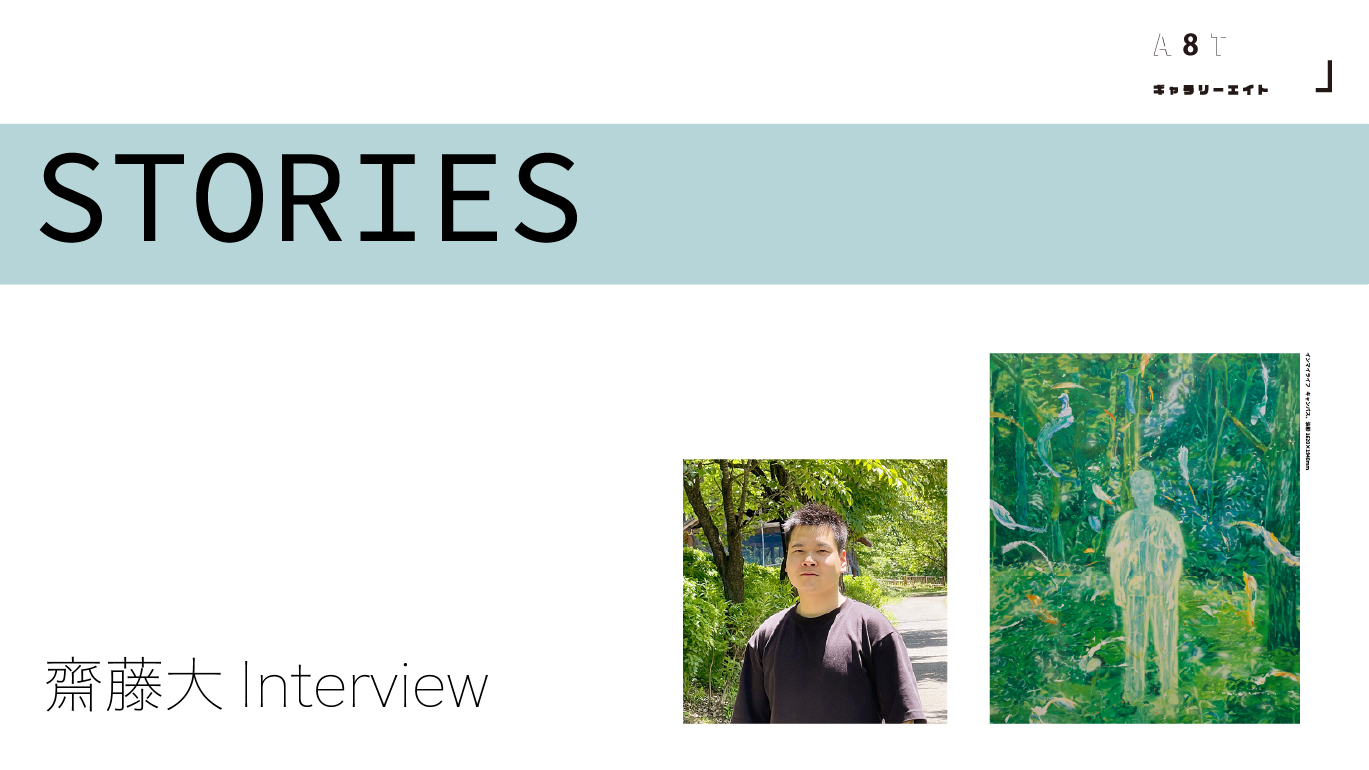
In the world of professional caregiving, where one faces the raw realities of life and death, there is a painter who turns to his canvas as soon as he returns home.
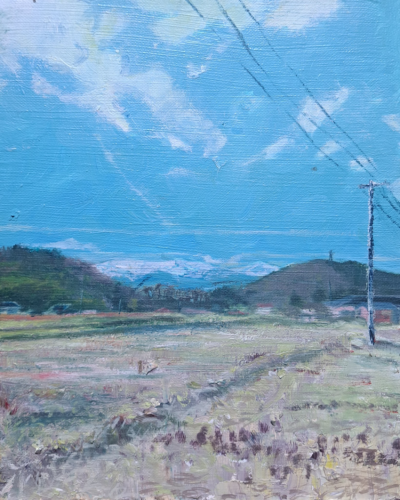
That artist is 25-year-old Dai Saito. In a room filled with the lingering scent of oil paint, he quietly captures the fragments of everyday life that he finds beautiful and fixes them onto the canvas. Having completed his graduate studies this spring and stepped into the professional world, Saito now balances his life between his career as a caregiver and his vocation as an artist, continuing to paint with the central theme of “living.” We spoke with him about his journey—from his first encounter with the joy of painting to his time at art school and the profound themes behind his work.
Interview by Seriko Ishiyama (GALLERY A8T)
Profile Dai Saito Born in 2001 in Shiroishi, Miyagi Prefecture.
Graduated from the Department of Fine Arts (Oil Painting) at Tohoku University of Art and Design, and completed his master’s degree in the Painting Research Program at the same university in March 2026.
Notable achievements include being selected for the “Idemitsu Art Award 2024” and winning the Grand Prix at the “FACE Exhibition 2025.”
He explores the theme of “living” by depicting “landscapes where figures merge.” Starting June 27, 2026, he will hold his solo exhibition, Dai Saito: “Painting 〜Life Goes On〜,” at GALLERY A8T.

── To begin, could you tell us about your first encounter with art?
I’ve loved drawing since I was a child. Before I could even put it into words, I was already moving my hands. I would trace game characters, animals, insects, and dinosaurs, and I would even make my own illustrated encyclopedias with detailed descriptions, or craft creatures out of cardboard. Looking back, I don’t think I saw it as “art” at the time; rather, it was a fascination with observing subjects and “reproducing” them.
── And how did that interest lead you to oil painting?
When I first touched oil paint in high school, I knew instantly: “This is it.” The fact that it dries slowly was incredibly appealing to me. It felt like I could manipulate the paint as long as I needed to, much like kneading clay. Honestly, I’m not particularly skilled at the delicate expressions required for watercolor, but I felt that the boldness of oil painting really suited me. It felt more like “constructing” than just “drawing.”
That approach soon brought results. By discovering a technique that felt comfortable, I won awards at the Sennan High School Art Exhibition and the Miyagi Prefectural High School Art Exhibition, which gave me a great deal of confidence.
── It is said that at Tohoku University of Art and Design, you experienced a time where that confidence wavered.
That’s true. At university, I tried to move beyond my comfort zone and chase a sense of “artistic individuality” that I thought I should have. I experimented with various techniques, painting and reflecting endlessly. But even when I felt I had captured a certain style, it would eventually feel like “something borrowed”—a style that never truly took root within me.
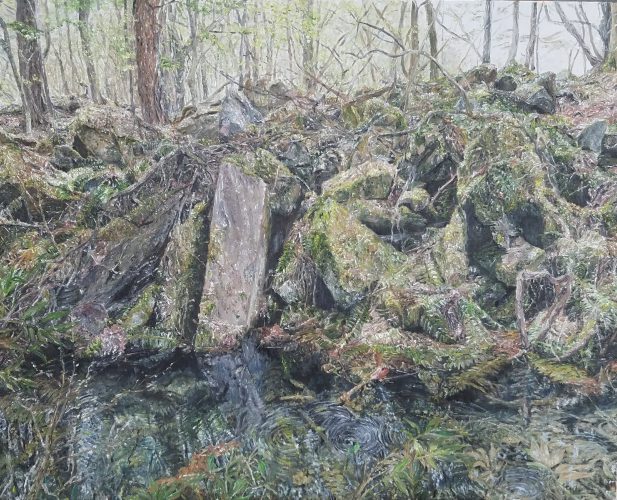
During my first three years of undergraduate study, I struggled. The paradox I arrived at was to “cherish what is already there.” I returned to the roots I had once set aside—the “tracing” and “landscape painting” I had done since childhood. My undergraduate years were, in a sense, a long detour. But looking back, I realize that the process allowed me to understand myself. My professor once told me, “In the history of art, nothing is entirely new; art develops by reinterpreting the past.” That sentiment remains the axis of my work today.
── Your graduation project served as a turning point, didn’t it?
Yes. I went to graduate school because I wanted to delve deeper into the possibilities I saw in my graduation project. As I faced landscape painting, I felt my direction suddenly broaden.

── Your master’s completion project was themed around “living.”
In modern society, I feel as though the sense of actually being alive is becoming increasingly faint. In my work, I tasked myself with reclaiming that sensation. Through the experience of camping in the mountains and immersing myself in nature, I felt more strongly than ever that “living” is not something separated from nature, but something that exists within its cycle. I worked to express that through painting for my completion exhibition.

── How did you feel when the exhibition was over?
I felt a sense of accomplishment, but honestly, I felt more of a lingering sadness—like something had come to an end. It might sound self-centered, but to me, the time spent painting is more brilliant than the finished work itself. Perhaps the sadness comes from the realization that once it’s finished, I cannot return to that specific moment.
── You have a style of working in intense bursts, finishing a piece in three days.
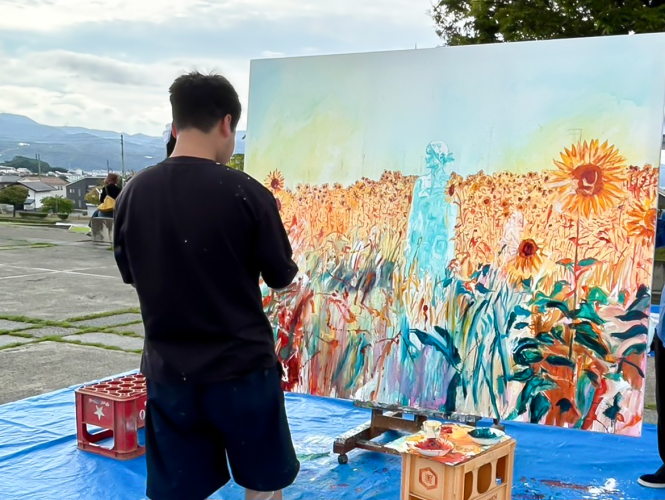
On the first day, I decide on the rough sketch and composition. On the second day, I fill the entire canvas with oil paint, and on the third, I adjust the details and finish it. Since I plan the process before I start, I rarely get lost during production; I just work while thinking about how genuinely fun it is. My criteria for completion is the feeling that “if I add any more brushstrokes, the canvas will become too noisy.” I carefully balance the image by adding and erasing. I don’t have a specific routine; painting is just something that “exists” as an extension of my daily life. It begins naturally and ends naturally.

── Do you have any hobbies to refresh yourself?
I enjoy everything—animation, manga, music, regardless of genre. With music, I tend to listen to the same songs on repeat; I listen to the band Sakanaction quite often. Recently, I’ve been immersed in building cities while playing Minecraft.
── You are currently balancing your art with a career in caregiving.
At the home where I work, I interact with many people daily—from those who are vibrant and energetic to those suffering from dementia or nearing the end of their lives. Being in an environment where the life and death of others is so immediate has made my consciousness of “living” much heavier and more profound than before. My theme remains the same, but I feel it has evolved into something quieter and deeper.
── What are you thinking about regarding your future work?
Death is an extremely heavy reality for those directly involved, yet it passes by with surprising indifference for others. I am contemplating how to express that strange contradiction through painting.

── Finally, what kind of presence would you like your paintings to have in people’s lives?
I want them to be like a part of daily life. I don’t want them to demand too much attention; if someone catches a glimpse of one and simply feels, “That’s a nice painting,” then that is enough for me.
To me, “painting” is a part of life—like the layers of skin we shed. It is a very personal act, but I would be happy to share the fragments of everyday life—the colors, the light, and the shapes that I find beautiful—with someone else.
Exhibition Information
Dai Saito Solo Exhibition: “Painting 〜Life Goes On〜”
Dates: June 27(Sat) – July 11(Sat) , 2026
Hours: 12:00 – 19:00 (last entry 18:00)
Closed: July 4 (Sat) , July 5 (Sun)
Venue: GALLERY A8T
Address: 2-5-7 Oroshimachi, Walabayashi-ku, Sendai, Miyagi, 984-0015
Admission: Free